


Abstract
Macrophage Migration Inhibitory Factor (MIF) is a multifunctional cytokine that plays a pivotal role in immune regulation, inflammation and disease pathogenesis. Unlike classical cytokines, MIF exhibits unique structural and biochemical properties, including enzymatic activity and non-classical secretion, enabling rapid immune responses. This review aims to provide a detailed overview of the molecular structure, biosynthesis, signaling pathways, functional properties and pathophysiological roles of MIF, with a focus on its therapeutic potential. A narrative synthesis of current literature conducted integrating findings on MIF structure, receptor-mediated signaling, immune functions and involvement in various diseases, as well as also analyzed recent advances in therapeutic targeting and biomarker applications. MIF regulates key signaling pathways, including MAPK/ERK, PI3K/Akt, and NF-κB, influencing inflammation, cell survival and immune responses. It plays critical roles in physiological processes such as host defense, tissue repair and immune homeostasis. Dysregulation of MIF contributes to inflammatory, autoimmune, metabolic, cardiovascular, infectious diseases and cancer. Emerging therapies targeting MIF, including small molecule inhibitors and monoclonal antibodies, demonstrate promising clinical potential. MIF serves as a central mediator linking immune regulation with disease progression. Despite its therapeutic promise, challenges related to its multifunctionality and complex signaling networks remain. Future research should focus on targeted interventions and precision medicine approaches to optimize MIF-based therapies.
Full article
Cytokines are an eclectic family of miniature signal proteins that are central to the regulation of immune actions, as well as to physiological homeostasis. They are engaged in numerous biological processes, such as cell proliferation, differentiation, inflammation and apoptosis. The cytokines are significant in the process of interaction between immune or non-immune cells in order to synchronize the reply to infection, harm and stress. However, the asymmetry in the generation or release of cytokines significantly attributed to the development of other pathological disorders, including chronic inflammatory diseases, cardiovascular issues and cancer [1]. Because of the intricacy of the cytokine networks and their pleiotropicity, cytokines are the focus of both the health and the diseases and accumulating evidence is linking the existence of circulating inflammatory mediators to the risk and progression of cancers [2].
Macrophages are one of the greatest providers of cytokines in the body and they are crucial to the immune system control. These are very plastic cells that respond to the environmental cues and can take different functional phenotypes depending on the physiological or pathological circumstances. Macrophages are involved in the host defense, repair process and homeostasis of inflammatory processes in tissues. They can coordinate the recruitment or activation of immune cells due to cytokines and chemokine. One of the major pathogenesis of such chronic respiratory illnesses as chronic obstructive pulmonary disease is a macrophage functional alteration [3]. Furthermore, such chemokine as CXCL8 and CXCL12 show the complexity of the cytokine signaling pathways as they regulate the circulatory leukocytes and define the pathogenesis of some diseases [4].
Among the cytokines that initially identified is the so-called Macrophage Migration Inhibitory Factor (MIF) that holds a niche in the field of immunology. In 1960, MIF was initially defined as the soluble factor that was released by activated T lymphocytes and inhibited the macrophage migration, initially associated with delayed-type hypersensitivity reactions [5, 6]. Over time, it has been determined that MIF is developed by tremendous masses of cells incorporating macrophages, T cells, epithelial cells and endocrine cells. Compared to a number of classical cytokines, MIF constitutively expressed, accumulated within cells, extremely rapidly released in response to stress or inflammatory stimuli. MIF has structural and functional differences with the majority of other cytokines. It is also multifunctional because it possesses an enzymatic activity along with cytokine-like activities [7]. MIF can regulate immune response by binding to such receptors as CD74 receptor and chemokine receptor that consequently causes vital intracellular signaling pathways to become active. The pathways participate in the control of inflammation, cell division and survival, therefore, the primary role of MIF in the immune system regulation. Moreover, MIF is the only one that has the capacity to prevent glucocorticoids' immunosuppressive effects while maintaining inflammatory responses even on the condition of regulation [8].
The biological significance of MIF also supported by the fact that MIF plays a role in numerous diseases. MIF levels observed to be high in inflammatory and autoimmune diseases such as rheumatoid arthritis and systemic lupus erythematous, where it identified in the cause of chronic inflammation and tissue destruction [9]. Additionally, macrophages mediate inflammatory processes that are significant in cardiovascular diseases and cytokine-mediated signaling pathways influence the emergence of the disease and therapeutic target treatment [10]. Because of its multifunctional character and its fundamental position in the pathogenesis of diseases, MIF has become a possible treatment target. Additional research that is underway is also trying to explain its molecular structure, signaling cascades and interactions with other cytokines in order to develop certain therapeutic interventions. The review at hand attempts to provide a better description of the MIF, its chemical construction, and functionalities and how participated as a cytokine in disease. One of the purposes of the review is to introduce the importance of MIF in physiological and pathological processes, how translated into the synthesis of available information regarding the molecular character and the biological activity of this substance and determining the way of research in the future.
The Macrophage Migration Inhibitory Factor (MIF) is a structurally conserved cytokine that has unique biochemical and molecular features that distinguish it among classical cytokines. It is a gene that is found as chromosomes 22 and manifests in many immunological and non-immune cells. MIF is a small protein that is enzymatically active and has a distinctive trimeric structure, which allows to interact with receptors and to transmit a signal. The secretion of it is not classical and multifunctional making it so important in immune regulation, inflammation, and pathogenesis of diseases.
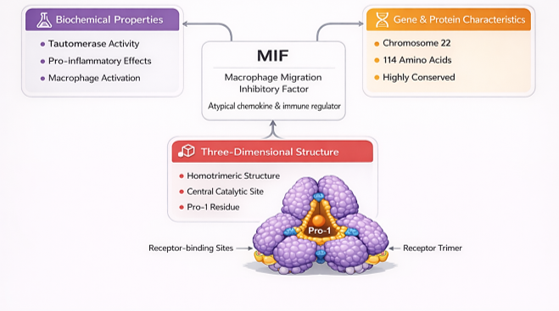
The gene MIF, or macrophage migration inhibitory factor, is on the chromosome 22 (22q11.2) which expressed constitutively in a broad immune and non-immune cells. It is quickly induced in reaction to inflammatory and stress-related conditions, which emphasizes its role in immunological processes and pathogenesis of diseases. MIF is a low-sized protein made up of 114 amino acids and its molecular mass is about 12.5kDa [7]. It is interesting to note that it does not have a classic signal peptide and it is released through a non-classical pathway. MIF strongly conserved in all the species, which means that it plays an essential role in evolution in terms of immune regulation and cellular communication [11]. The crystallographic studies have been used to elucidate the three-dimensional configuration of MIF, which is a homotrimeric structure composed of three different subunits. These three-fold structures create a central channel, which is very vital in its biological action and in relations with receptors. The structural organization facilitates the work of MIF in immune signaling and inflammatory mechanisms. The monomers are bound at the interface and the catalytic sites are found with Proline-1 (Pro-1) being one of the active residues. These regions of the active site promote both the enzymatic activity and functional versatility of the protein and facilitate its role in immune regulation and disease processes [12].
MIF has unique biochemical properties, such as tautomerase enzyme activity, which unlike most classic cytokines distinguishes it. There is still no clear understanding of the nature of the physiological contribution of this activity, but it presumed that it has a role to play in its pro-inflammatory activities. Moreover, MIF has an effect on the macrophage activation and polarization, as a result on the immune responses and the inflammation. The multifunctionality of its enzymatic and cytokine-like characteristics complement each other. These biochemical characteristics also support the dual nature of MIF as a signaling molecule and an enzyme, which is important to emphasize its importance in the immune modulation and pathophysiology [13].
Figure 1 illustrates the main structural and biochemical properties of MIF such as its gene and protein properties, three-dimensional structure that is homotrimers and its enzymatic properties. It emphasizes the preserved amino acid structure, catalytic positions like Pro-1 and its involvement in the pro-inflammatory and macrophage activation effects as a non-standard chemokine and immune regulator.
Produced by a large diversity of immune cells and MIF are likewise tightly controlled at the transcriptional or post-transcriptional levels in non-immune cells. In contrast to classical cytokines, MIF is not stored in vacuoles of the cell walls, but is released via a non-classical secretion pathway (in response to infection, hypoxia, and inflammation). It is released rapidly and is thus able to induce early immune signaling. The role of MIF production and secretion in inflammatory and immune-mediated conditions, as well as dysregulation in functions of play a key role in immune homeostasis and pathophysiology. MIF secretion and regulation is a closely regulated process that requires a number of cellular sources and stimuli as illustrated in Table 1.
The major processes involved in the MIF biosynthesis, control, and secretion summarized in Table 1, which briefly presents its cellular location, regulatory and release pathways. These processes further discussed in the following subsections and illustrated how they contributed to immune regulation and pathogenesis of diseases. Macrophage Migration Inhibitory Factor (MIF) is a ubiquitous expression in both macrophages, T lymphocytes, dendritic cells, epithelial cells, and other immunological, as well as non-immune cells of endocrine tissues. Among them, the most important source is macrophages since the latter are at the center of immune surveillance and inflammatory processes. The wide cellular localization of MIF also indicates the significance of MIF in the coordination of innate and adaptive immunity. The rapid mobilization of immune challenges is made possible by its constitutive expression which enables it to respond quickly to stress and infection. The prevalence of this indicates the role of MIF in physiological control as well as the pathogenesis of diseases, especially those involving inflammatory and immune-mediated mechanisms [14].
MIF both transcriptional and post-transcriptional levels of expression are tightly controlled stage so maintained an equal immune response. Other cytokines and especially interleukin family members are also important in regulating the expression of MIF gene using complicated signaling pathways. MIF is improved quickly by inflammatory pathways, such as those induced in infection or tissue damage. This control mechanism enables immune cells to react effectively to external stimuli and at the same time achieve homeostasis. Nonetheless, the disorders in the regulation of these pathways may lead to overproduction of MIF that causes persistent inflammation and the emergence of the disease. Therefore, it is crucial to regulate MIF expression to avoid excessive or insufficient immune responses and avoid pathological consequences [15].
In contrast to the classical cytokines, MIF released through a non-classical pathway, which circumvents the endoplasmic reticulum- Golgi apparatus. Rather it is accumulated in ready intracellular pools and is released immediately in response to stimulation. This special secretion system allows MIF to perform the role of an early communicator in immune responses allowing instant communication between cells. There is also the lack of a signal peptide which makes MIF unlike classical secretory proteins. Quick the activation of inflammatory pathways and immune cell responses can be achieved by rapid release of MIF. The non-conventional approach of secretion also increases its utility in the functional sense and emphasizes its significance as a key regulator of acute and chronic inflammatory states [16].
The release of MIF provoked by numerous stimuli, among which mentioned microbial products, hypoxia, oxidative stress and inflammatory signals. These stimuli cause immune cell activation and the massive release of MIF into the extracellular space. Also, chemokine binding and receptor-mediated signaling pathways play a role in controlling MIF release, which is indicative of its incorporation into larger immune networks. The implication of cytokines and chemokine interaction on the coordination of immune responses emphasized by the role of chemokine systems. This release process, which triggered by the presence of stimuli, makes sure that MIF released during severe immune ones, which allows a proper response to pathogens and affects the process of inflammation [17].
MIF secretion is one of the essential factors in the etiology of several inflammatory and immune mediated illnesses. As an upstream regulator, MIF increases inflammatory cascades through stimulation of production of cytokines and recruitment of leukocytes. It is an important mediator of the disease progression due to its capacity to connect cellular stress signals with immune activation. High levels of MIF are linked with chronic inflammatory diseases, in which recurrent stimulation of immune systems results in the destruction of tissue. MIF has therefore attracted interest as an attractive therapeutic target. It is necessary to comprehend its dynamics of secretion and regulation in order to create specific interventions that would allow regulating excessive inflammation and achieve better clinical outcomes [18].
Receptors and Signaling Pathways. Macrophage Migration Inhibitory Factor (MIF) has its living actions by binding to certain cell surface receptors, usually the CD74 receptor; commonly conjugated with other receptors like CD44 and chemokine receptors. These interactions promote various intracellular signaling pathways such as MAPK/ERK, PI3K/Akt and NF-kB that control cell survival, cell proliferation and inflammatory response. MIF alters immune cell activation, cytokine production and gene expression via these signaling pathways and is a key mediator of physiological regulation, as well as of disease development [19]. MIF has biological actions that counteract through engagement with distinct cell surface receptors, predominantly CD74, which has the high affinity binding receptor. CD74 also has a tendency to bind with co-receptors such as CD44 to mediate signal transduction and the resultant cellular responses. In addition, MIF also interacts with chemokine receptors and can be an uncharacteristic chemokine, including CXCR2, CXCR4, and CXCR7, which mediate the formation of immune cells and inflammatory processes [20]. MIF and its receptors have a relationship that is crucial to the immune system regulation and pathogenesis. On the one hand, these receptor complexes activate several signaling pathways that influence the macrophage behavior including migration, activation and polarization. The MIF role in leukocyte traffic and inflammatory response enhanced by the activity of chemokine receptors; ties the interaction of receptors with immune control processes to a larger scale that observed in autoimmune and inflammatory diseases [21]. The binding of MIF triggers a number of intracellular signaling pathways in response to its receptors, including the MAPK / ERK cascade that regulates cell proliferation, differentiation and survival. The pathway plays a vital role in the mediating process of inflammatory responses and immune cell activation.
As shown in Figure 2, MIF can interact with cell surface receptors, such as CD74, CD44 and chemokine receptors (CXCR2, CXCR4, CXCR7), triggering the activation of MAPK/ERK, PI3K/Akt, and NF- kB pathways. All these signaling cascades control production of cytokines, cell survival and immune response and eventually leading to inflammation, macrophage activation and disease progression. The amplification of cytokine production and the overall enhancement of the immune process are signaling facilitated by MIF, which occurs in case of illnesses [22]. MIF also initiates PI3K/Akt pathway that enhances cell survival and resistance to apoptosis. It also leads to the activation of NF-KB pathway that is a significant regulator of inflammatory expression of genes. It reported that MIF interacts with the tumor suppressor protein - p53 and reduces its functions and, therefore, results in cell survival and proliferation under stressful conditions [23]. The clinical implication of the MIF involvement in these signaling pathways is of significance particularly in cancer and inflammatory diseases. MIF is an emerging possible therapeutic target. These are MIF-neutralizing antibodies, the presence of which in clinical studies has demonstrated the possibility to control the progression of the disease and improve the therapeutic outcomes of patients with advanced malignancies [24].
MIF's function in innate immunity is it regulates the activation of macrophages the phagocytic function and the cytokine generation process. It enhances the reaction of the innate immune cells to respond rapidly to the pathogens and stress signals. Furthermore, MIF influences the macrophage polarization to a pro-inflammatory one that needed to protect the host but may eventually result in the emergence of the disease in case of a chronic disease [25]. MIF in adaptive immunity controls the T-cell activation, proliferation and differentiation thereby determining antigen specific immune response. It aids in the preservation of the immune activation through the regulation of cytokines production and the lymphocytes recruitment. MIF also plays a role in preserving immune memory as well as augmenting of the inflammation signaling. The regulatory issues of such processes also can result in the emergence of chronic inflammatory diseases and immune-mediated pathology [26].
Macrophage Migration Inhibitory Factor (MIF) has a wide range of functional ability that spans over immunological, inflammatory, hormonal and enzymatic functions. It has a crucial part in the control of innate and adaptive immune responses, in the regulation of macrophage activity, T-cell functions and cytokine production. MIF is also a strong pro-inflammatory mediator, which increases immune signaling and leukocyte recruitment. It also overcomes immunosuppression caused by glucocorticoids, and it is enzymatic which demonstrates that it is multifunctional in keeping the immune balance and is a part of disease pathogenesis [8]. MIF is a powerful pro-inflammatory cytokine that regulates other inflammatory mediator production and release. It enhances the manufacture of cytokine such as TNF- α, IL-1, and IL- 6 that enhances the inflammatory processes. MIF is an upstream mediator of the inflammatory process, which is part of the disease process of the condition showing hyperirritable immune reactions [27]. MIF also plays a role in the process of cell recruitment of the leukocytes because it recognizes with the chemokine receptors, and helps in the movement of the cells into the inflammatory areas. It elevates the adhesion molecule expression and there is trafficking of immune cells. These functions are fundamental to effective immune responses but at excessively elevated leukocyte recruitment, tissue destruction and chronic inflammation ensues particularly in autoimmune disease and other degenerative diseases [28].
Figure 3 illustrates that the MIF controls the major physiological processes such as host defense, immune control, cell growth and survival. It helps to repair tissue, sustain vascular activity as well as polarize macrophages and keep immune balance. With such coordinated efforts, MIF is at the center of tissue homeostasis and the adaptation to physiological stress. The MIF plays other roles, which explained further in the subsection.
MIF is a protective molecule that regulates the inflammatory reaction and cells regeneration after injury through repairing tissues. It improves the healing by regulating the production of cytokine and functions of immune cells, hence reduces tissue damage. Under acute injury to the kidney, MIF has shown protective properties in inhibiting cell injury and promoting regeneration. The functions show how it promotes tissue resilience and tissue recovery. MIF promotes physiological healing and repair processes by balancing the elements of inflammation and repair, as well as normal tissue architecture restoration [32].
MIF is a major mediator of macrophage polarization, which affects the pro-inflammatory (M1) to anti-inflammatory (M2) polarization. This homeostatic equilibrium is necessary in keeping the immune homeostasis and repairing tissues. MIF controls the macrophage plasticity to make sure that there are proper responses to the immune system, whether it is inflammatory or recovery. This is because the immune system is capable of adjusting to altering physiological states through its regulatory capability to provide defense and regenerate. This control over macrophage activity highlights the need to use MIF in balancing between immune activation and inflammatory repair [33].
Besides its systemic processes, MIF is also important in ensuring homeostasis of tissues in specialized microenvironment like periodontal tissues. It controls immune signaling and cellular communications that are needed to maintain tissue integrity. MIF provides normal tissue functionality and stability of the architecture by regulating localized inflammatory reactions and macrophage dynamics. These control mechanisms help to sustain protective immunity and avoid over-damage of inflammatory lesions. MIF, therefore, helps to ensure physiological balance, both systemic and local, and it is important to emphasize the importance of MIF in preserving normal tissue architecture and immune equilibrium [34].
Macrophage Migration inhibitory factor (MIF) is an important factor in the pathogenesis of a broad group of diseases, as it regulates immune and inflammatory reactions. It leads to the inflammatory and autoimmune diseases via the long-term effect of the production of cytokines and the activation of immunity [8]. MIF enhances the development of tumors, angiogenesis, and immune evasion in cancer. It also participates in metabolic, cardiovascular and infectious diseases, balancing inflammation and cellular reactions and it is important to note that it is also a major founder of disease progression and a potential therapeutic goal.
The MIF is an essential factor in the pathogenesis of inflammatory and autoimmune diseases that control the production of cytokines and the activity of immune cells. It is an upstream mediator, which increases inflammatory reactions resulting in tissue destruction in rheumatoid arthritis, sepsis or inflammatory bowel disease. MIF promotes chronic inflammation and cytokine signaling sustainment in autoimmune diseases, such as systemic lupus erythematous and multiple sclerosis. This cumulative inflammatory and autoimmune pathophysiology leads to tissue damage and severity of disease, which shows the key role of MIF in the process of these mechanisms [35]. Table 3 summarizes the essential pathophysiological roles of MIF in different disease categories, and it will give the reader the overview of how it is involved in immune regulation and disease progression. Its particular contributions to individual disease conditions with underlying mechanisms and clinical importance elaborated in the following subsections.
MIF is gaining acceptance as an important controller of cancer development and progression. It stimulates tumor growth, metastasis and angiogenesis by regulating tumor microenvironment and stimulating inflammatory signaling. MIF is also implicated in immune evasion that modulates immune cell reactions and contributes to the survival of tumors. MIF affects the macrophage polarization to tumor-supportive phenotypes, which induces the further development of cancer through the activation of the pathways including STAT3. Such mechanisms lead to a higher level of tumor aggressiveness, vascularization, and resistance to treatment, which makes MIF one of the key factors of oncogenesis and a possible cancer treatment target [36].
MIF has a significant contribution to metabolic diseases like diabetes and obesity as it enhances chronic low-grade inflammation and insulin resistance. It promotes the metabolic imbalance through control of the inflammatory pathways that suppress the glucose metabolism and energy homeostasis. Further, MIF has a role in cardiovascular diseases, such as atherosclerosis and myocardial infarction, because it affects vascular inflammation and endothelial malfunction. Its involvement in the stimulation of immune cells connects the disturbances in metabolism to the cardiovascular complication. In such ways, MIF becomes a key mediator between metabolic and cardiovascular pathologies, which is important to note and a therapeutic target [37].
MIF is also a major innate immune regulator of host responses to bacteria, viruses and parasites in infectious disease. It also augments the macrophage activation and inflammatory signaling, which helps to clear the pathogen efficiently. MIF has a dual role and assists with the protective immunity, as well as, it may also contribute to the increase in the severity of the disease in case of overexpression. Excessive inflammation or tissue damage may occur with elevated levels of MIF especially in severe infections. In respiratory diseases, MIF play a role in the dynamics of immune responses and disease pathogenesis in relation to the changes in macrophage phenotypes. These results underscore the complicated task assigned to MIF in the process of maintaining the equilibrium between host defense and inflammatory injury [38].
The concept of therapeutic targeting of the Macrophage Migration Inhibitory Factor (MIF) has become one of the promising approaches in the treatment of inflammatory, autoimmune and malignant diseases (Figure 4). Potential strategies like small molecule inhibitors, monoclonal antibodies and immune modulatory therapy targeted to inhibit the interactions between MIF-receptor or to inhibit its enzymatic activity. These treatments can decrease inflammation, modify the polarization of macrophages and prevent the development of the disease. Moreover, MIF can be regarded as a promising disease severity and treatment response biomarker, so it is a significant object of targeted and precision-focused therapy development.
Macrophage Migration Inhibitory Factor (MIF) has become a target of interest using small molecule inhibitors, as well as monoclonal antibodies to inhibit its migration in immune-associated and inflammatory diseases. The mechanism of action of these agents is preventing the interaction between MIF and receptors or inhibiting its enzymatic activity in order to decrease the process of inflammatory signaling and disease development. It is also important to note that targeting MIF can alter macrophage plasticity and immune cell responses, which suggest its curative potential in chronic inflammatory and regenerative disease. The creation of these inhibitors demonstrates an increasing interest in MIF as an immune dysregulation mediator and a potential target of the therapeutic intervention [39].
Figure 4 shows the approaches to targeting the migration inhibitory factor (MIF) of macrophages and use of small molecule inhibitors, monoclonal antibodies. The ways inhibit CD74/CXCR receptors and enzymatic activity, which results in less inflammation, altered polarization of macrophages and lower tumor progression. It used clinically in the treatment of autoimmune diseases, cancer, and diagnostics, monitoring based on biomarkers and considered further in the following subsections. MIF monoclonal antibodies found to have a great potential of neutralizing its biological activity especially in cancer and in autoimmune diseases. These treatments expected to interfere with the signaling pathways mediated by MIF, which will lead to a decrease in tumor progression, immune evasion and chronic inflammation. Moreover, new cell-based therapies, including mesenchyme stem cell therapies can indirectly suppress the activity of MIF via immune modulatory actions. These modalities provide novel treatment opportunities because they act at several immune regulation levels and the opportunities of MIF-targeted therapies are further expanded [40].
MIF studied widely in clinical and experimental research as a target therapy and a biomarker. High amounts of MIF have been linked to severity of different pathological diseases, implying that it would be useful in diagnosis and treatment follow up. Continued studies are being done to create more selective and effective MIF inhibitors which can be used in clinical practice. MIF-focused therapies used in combination with biomarker-based interventions to improve personalized treatment plans and increase patient outcomes in patients with inflammatory and immune-mediated diseases [41]. Although MIF has a therapeutic potential, a number of obstacles restrict the optimal targeting of the drug. The multifunctional character, prevalence and participation in protective, pathological mechanisms make it difficult to develop therapeutic strategies. Moreover, compensatory immune responses and cellular heterogeneity can also have an effect on treatment efficacy. The further study of the diversity of immune cells and the inflammatory signaling networks should be the key to the development of more specific and effective interventions. The future studies should aim at addressing these shortcomings to maximize on MIF-based therapies and to translate them into clinical practice [42].
Recent progress in Macrophage Migration Inhibitory Factor (MIF) studies has increased knowledge on the role of this molecule in the process of inflammation, immune compromises and disease development. Recent findings emphasize its role in cardiovascular pathology, remodeling of tumor microenvironment and polarization of macrophages, which strengthen the importance of this cytokine as a multifunctional one. According to the emerging therapeutic research, MIF can be used as biomarker or drug target in various ailments. Further studies ought to base on shedding more light on its dual protective and pathological functions, enhanced strategies of selective targeting and translation of the experimental results to effective clinical applications.
Recent developments in the biological study of MIF have made it known to be a key mediator in inflammatory pathways and pathogenesis. Ample evidence is emerging that MIF plays a major function in the development of cardiovascular disease by regulating pro-inflammatory cytokines and immune cells, affecting vascular inflammation and remodeling. These results broaden the concept of MIF as a conventional cytokine, making it an important mediator of systemic diseases. Moreover, its role in various signaling pathways also highlights the significance of MIF in translational studies, in which the targeting MIF may expand new treatment opportunities that used to treat sophisticated inflammatory and cardiovascular diseases [43].
Recent researches have revealed that MIF is a key player in tumor microenvironment development because of its interaction with stromal and immune cells. MIF has been reported to be found in cancer-associated fibroblasts as one of the major contributors of immunosuppressive states that promote tumor growth and progression. MIF facilitates immune evasion, tumor cell growth and survival of tumor cells thus increasing cancer aggressiveness and resistance to treatment. The insights offer new directions to cancer treatment approaches, which focus on the possibility of interfering with tumor-supportive functions with the help of targeting MIF to enhance the efficacy of therapeutic approaches in oncology [44].
The future of MIF research aims at coming up with very specific therapeutic measures and its multifaceted role in the immune modulation. Innovations in the polarization of the macrophage have provided new opportunities in immunotherapy by further connecting MIF functionality to immune cell differentiation and function. Nevertheless, several gaps in the research have not been filled, such as the necessity to provide specific targeting methods and a better comprehension of the dual functions of MIF in protective and pathological mechanisms. These issues will be required to apply the outcome of experiments to clinical practice and make the most of MIF-based treatment plans to various diseases [45].
CONCLUSION Macrophage Migration Inhibitory Factor (MIF) has become a versatile cytokine that is essential for inflammation, immunological control and pathogenesis of diseases. Its distinctive structural characteristics, such as enzymatic activity, non-classical secretion those are what make it unlike other conventional cytokines, allow quick immune response. MIF combines several signaling pathways, including MAPK/ERK, PI3K/Akt, and NF-kB, therefore, it controls cell survival, proliferation and inflammatory responses. Concisely, it is essential for mediating the relationship among innate and adaptive immunity, physiological and pathological effects through these mechanisms. Notably, MIF is the cause of a broad range of diseases, among which are inflammatory, autoimmune, metabolic, cardiovascular, infectious disorders and cancer. Its association with the disease progression is depicted by its position as an upstream regulator of cytokine generation and activation of immune cells. Meanwhile, MIF plays a role in both protective and pathological activities as it implicated in the physiological processes that are necessary to maintain host defense, tissue repair and immune homeostasis. MIF has therapeutic promise and there are still advances underway on small molecule inhibitors, monoclonal antibodies and immune modulatory approaches. Nevertheless, problems associated with its multifunctionality, ubiquitous expression and intricate networks of signals continue to be major obstacles to clinical translation. Future studies are needed to enhance specificity of the target, context-dependent functions and incorporate MIF-based techniques in precision medicine. In sum, MIF is an extremely important bridge between immune control and pathology, which has much potential in diagnostic and therapeutic innovation.
Figures
Keywords
References
1.Amin MN, Siddiqui SA, Ibrahim M, et al. Inflammatory cytokines in the pathogenesis of cardiovascular disease and cancer. SAGE Open Med. (2020);8: 2050312120965752. doi:10.1177/2050312120965752
2.Bouras E, Karhunen V, Gill D, et al. Circulating inflammatory cytokines and risk of five cancers: a Mendelian randomization analysis. BMC Med. (2022); 20(1):3. doi:10.1186/s12916-021-02193-0
3.Akata K, van Eeden SF. Lung Macrophage Functional Properties in Chronic Obstructive Pulmonary Disease. Int J Mol Sci. (2020);21(3):853. doi:10.3390/ijms21030853
4.Cambier S, Gouwy M, Proost P. The chemokines CXCL8 and CXCL12: molecular and functional properties, role in disease and efforts towards pharmacological intervention. Cell Mol Immunol. (2023);20(3):217-251. doi:10.1038/s41423-023-00974-6
5.Bennett B, Bloom BR. Studies on the migration inhibitory factor associated with delayed-type hypersensitivity: cytodynamics and specificity. Transplantation. (1967);5(4):996-1000.
6.Bloom BR, Bennett B. Relation of the migration inhibitory factor (MIF) to delayed-type hypersensitivity reactions. Ann N Y Acad Sci. (1970);169(1):258-265. doi:10.1111/j.1749-6632.1970.tb55994.x
7.Aliyarbayova A, Sultanova T, Yaqubova S, Najafova T, Sadiqova G, Salimova A. Macrophage Migration Inhibitory Factor: Its Multifaceted Role in Inflammation and Immune Regulation Across Organ Systems. Cell Physiol Biochem. (2025);59(5):569-588. doi:10.33594/000000809
8.Aliyarbayova A., Hajiyeva Y., Pashayeva S., Qaniyeva G., Qarayeva S., Mekhtiyeva A. Macrophage Migration Inhibitory Factor and Pulmonary Immunity: a Systems Biology Perspective on Its Role in Lung Diseases Cell Physiol Biochem 60(2), (2026), pp.223-244. DOI: 10.33594/000000864
9.Bilsborrow JB, Doherty E, Tilstam PV, Bucala R. Macrophage migration inhibitory factor (MIF) as a therapeutic target for rheumatoid arthritis and systemic lupus erythematosus. Expert Opin Ther Targets. (2019);23(9):733-744. doi:10.1080/14728222.2019.1656718
10.Chen R, Zhang H, Tang B, et al. Macrophages in cardiovascular diseases: molecular mechanisms and therapeutic targets. Signal Transduct Target Ther. (2024);9(1):130. doi:10.1038/s41392-024-01840-1
11.Dinarello CA. The IL-1 family of cytokines and receptors in rheumatic diseases. Nat Rev Rheumatol. (2019);15(10):612-632. doi:10.1038/s41584-019-0277-8
12.Coperchini F, Chiovato L, Croce L, Magri F, Rotondi M. The cytokine storm in COVID-19: An overview of the involvement of the chemokine/chemokine-receptor system. Cytokine Growth Factor Rev. (2020);53:25-32. doi:10.1016/j.cytogfr.2020.05.003
13.Cutolo M, Campitiello R, Gotelli E, Soldano S. The Role of M1/M2 Macrophage Polarization in Rheumatoid Arthritis Synovitis. Front Immunol. (2022);13: 867260. doi:10.3389/fimmu.2022.867260
14.Hu C, Zhang Y, Liu J, You Y, Wu F, Zhou H. Functional Property and Regulatory Mechanism of Macrophages in Complementary and Alternative Medicine: From Bench to Clinic. Iran J Immunol. (2024);21(2):103-120. doi:10.22034/iji.2024.99943.2668
15.Jones SA, Jenkins BJ. Recent insights into targeting the IL-6 cytokine family in inflammatory diseases and cancer. Nat Rev Immunol. (2018);18(12):773-789. doi:10.1038/s41577-018-0066-7
16.Kang I, Bucala R. The immunobiology of MIF: function, genetics and prospects for precision medicine. Nat Rev Rheumatol. (2019);15(7):427-437. doi:10.1038/s41584-019-0238-2
17.Janssens R, Struyf S, Proost P. The unique structural and functional features of CXCL12. Cell Mol Immunol. (2018);15(4):299-311. doi:10.1038/cmi.2017.107
18.Kany S, Vollrath JT, Relja B. Cytokines in Inflammatory Disease. Int J Mol Sci. (2019);20 (23):6008. doi:10.3390/ijms20236008
19.Kapurniotu A, Gokce O, Bernhagen J. The Multitasking Potential of Alarmins and Atypical Chemokines. Front Med (Lausanne). (2019);6:3. doi:10.3389/fmed.2019.00003
20.Farr L, Ghosh S, Moonah S. Role of MIF Cytokine/CD74 Receptor Pathway in Protecting Against Injury and Promoting Repair. Front Immunol. 2020; 11:1273. doi:10.3389/fimmu.2020.01273
21.Ma WT, Gao F, Gu K, Chen DK. The Role of Monocytes and Macrophages in Autoimmune Diseases: A Comprehensive Review. Front Immunol. (2019); 10:1140. doi:10.3389/fimmu.2019.01140
22.Meli VS, Veerasubramanian PK, Atcha H, Reitz Z, Downing TL, Liu WF. Biophysical regulation of macrophages in health and disease. J Leukoc Biol. (2019);106 (2):283-299. doi:10.1002/JLB.MR0318-126R
23.Lang T, Lee JPW, Elgass K, et al. Macrophage migration inhibitory factor is required for NLRP3 inflammasome activation. Nat Commun. (2018);9(1):2223. doi:10.1038/s41467-018-04581-2
24.Mahalingam D, Patel MR, Sachdev JC, et al. Phase I study of imalumab (BAX69), a fully human recombinant antioxidized macrophage migration inhibitory factor antibody in advanced solid tumours. Br J Clin Pharmacol. (2020); 86(9):1836-1848. doi:10.1111/bcp.14289
25.Shapouri-Moghaddam A, Mohammadian S, Vazini H, et al. Macrophage plasticity, polarization, and function in health and disease. J Cell Physiol. (2018);233(9):6425-6440. doi:10.1002/jcp.26429
26.Parisi L, Gini E, Baci D, et al. Macrophage Polarization in Chronic Inflammatory Diseases: Killers or Builders?. J Immunol Res. (2018):8917804.doi:10.1155/2018/8917804
27.Nasiri E, Sankowski R, Dietrich H, et al. Key role of MIF-related neuroinflammation in neurodegeneration and cognitive impairment in Alzheimer's disease. Mol Med. (2020); 26(1):34. doi:10.1186/s10020-020-00163-5
28.Park H, Kam TI, Peng H, et al. PAAN/MIF nuclease inhibition prevents neurodegeneration in Parkinson's disease. Cell. (2022); 185(11): pp.1943-1959. e21. doi:10.1016/j.cell.2022.04.020
29.Penticuff JC, Woolbright BL, Sielecki TM, Weir SJ, Taylor JA 3rd. MIF family proteins in genitourinary cancer: tumorigenic roles and therapeutic potential. Nat Rev Urol. (2019);16(5):318-328. doi:10.1038/s41585-019-0171-9
30.Sinitski D, Kontos C, Krammer C, Asare Y, Kapurniotu A, Bernhagen J. Macrophage Migration Inhibitory Factor (MIF)-Based Therapeutic Concepts in Atherosclerosis and Inflammation. Thromb Haemost. (2019);119(4):553-566. doi:10.1055/s-0039-1677803
31.Stenmark KR, Frid MG, Graham BB, Tuder RM. Dynamic and diverse changes in the functional properties of vascular smooth muscle cells in pulmonary hypertension. Cardiovasc Res. (2018);114(4):551-564. doi:10.1093/cvr/cvy004
32.Stoppe C, Averdunk L, Goetzenich A, et al. The protective role of macrophage migration inhibitory factor in acute kidney injury after cardiac surgery. Sci Transl Med. (2018);10(441):eaan4886. doi:10.1126/scitranslmed.aan4886
33.Strizova Z, Benesova I, Bartolini R, et al. M1/M2 macrophages and their overlaps - myth or reality?. Clin Sci (Lond). (2023);137(15):1067-1093. doi:10.1042/CS20220531
34.Sun X, Gao J, Meng X, Lu X, Zhang L, Chen R. Polarized Macrophages in Periodontitis: Characteristics, Function, and Molecular Signaling. Front Immunol. (2021);12: 763334. doi:10.3389/fimmu.2021.763334
35.Wautier JL, Wautier MP. Pro- and Anti-Inflammatory Prostaglandins and Cytokines in Humans: A Mini Review. Int J Mol Sci. (2023) ;24(11):9647. doi:10.3390/ijms24119647
36.Xia T, Zhang M, Lei W, et al. Advances in the role of STAT3 in macrophage polarization. Front Immunol. (2023); 14:1160719.doi:10.3389/fimmu.2023.1160719
37.Wang C, Zhou J, Wang J, et al. Progress in the mechanism and targeted drug therapy for COPD. Signal Transduct Target Ther. (2020);5(1):248. doi:10.1038/s41392-020-00345-x
38.Yamasaki K, Eeden SFV. Lung Macrophage Phenotypes and Functional Responses: Role in the Pathogenesis of COPD. Int J Mol Sci. (2018);1 9(2):582. doi:10.3390/ijms19020582
39.Yan L, Wang J, Cai X, et al. Macrophage plasticity: signaling pathways, tissue repair, and regeneration. Med Comm (2024);5(8):e658.. doi:10.1002/mco2.658
40.Yang G, Fan X, Liu Y, et al. Immunomodulatory Mechanisms and Therapeutic Potential of Mesenchymal Stem Cells. Stem Cell Rev Rep. (2023); 19(5): pp.1214-1231. doi:10.1007/s12015-023-10539-9
41.Yu JJ, Zhao Q, Li HN, Song JQ, Chen DC. MIFas a potential novel biomarker for cognitive function in patients with first episode schizophrenia. Aust N Z J Psychiatry. (2022); 56(3): 292-300. doi:10.1177/00048674211013086
42.Zhang F, Xia Y, Su J, et al. Neutrophil diversity and function in health and disease. Signal Transduct Target Ther. (2024);9(1):343. doi:10.1038/s41392-024-02049-y
43.Zhang H, Dhalla NS. The Role of Pro-Inflammatory Cytokines in the Pathogenesis of Cardiovascular Disease. Int J Mol Sci. (2024);25(2):1082. doi:10.3390/ijms25021082
44.Zhu GQ, Tang Z, Huang R, et al. CD36+ cancer-associated fibroblasts provide immunosuppressive microenvironment for hepatocellular carcinoma via secretion of macrophage migration inhibitory factor. Cell Discov. (2023);9(1):25. doi:10.1038/s41421-023-00529-z
45.Zhu W, Qiong D, Changzhi X, Meiyu J, Hui L. Macrophage polarization regulation shed lights on immunotherapy for CaOx kidney stone disease. Biomed Pharmacother. (2024);179:117336. doi:10.1016/j.biopha.2024.117336
Article Info:

Publication history

Published: 13.Oct.2026

Copyright
© 2022-2025. Azerbaijan Medical University. E-Journal is published by "Uptodate in Medicine" health sciences publishing. All rights reserved.Related Articles
We haven't found any related articles.
Viewed: 16