

Abstrakt
Tədqiqat Abşeron yarımadası şəraitində introduksiya olunmuş Salvia rosmarinus Spenn. bitkisinin saç dərisinin dermatozlarının törədicilərinə qarşı antimikrob aktivliyinin öyrənilməsinə həsr edilmişdir. İşin aktuallığı bu xəstəliklərin geniş yayılması və mikroorqanizmlərin ənənəvi antimikrob preparatlara qarşı artan davamlılığı ilə bağlıdır. Tədqiqatın məqsədi Salvia rosmarinus Spenn. bitkisinin efir yağı, həmçinin yerüstü və yeraltı hissələrindən alınmış su-spirt ekstraktlarının antimikrob aktivliyinin müqayisəli qiymətləndirilməsi olmuşdur. Tədqiqat obyektlərini 78 pasiyentdən ayrılmış klinik mikroorqanizm ştammları, eləcə də Staphylococcus aureus və Candida albicans referent kulturaları təşkil etmişdir, maddələrin aktivliyi isə disk-diffuziya üsulu və minimal inhibəedici konsentrasiyanın (MIC) təyini metodu ilə qiymətləndirilmişdir. Müəyyən edilmişdir ki, tədqiq olunan efir yağı ən yüksək antimikrob aktivlik göstərmişdir (MIC 0,5–1,25%). Yerüstü hissələrin ekstraktları orta dərəcədə təsir göstərdiyi halda, yeraltı hissələr zəif aktivlik nümayiş etdirmişdir. Oxşar nəticələr dermatofitlər və mayayabənzər göbələklər üçün də müşahidə edilmişdir. Əldə edilmiş nəticələr Salvia rosmarinus Spenn. efir yağının saç dərisinin infeksion dermatozlarının müalicəsi üçün fitoterapevtik vasitələrin hazırlanmasında perspektivli olduğunu təsdiqləyir.
Əsas mətn
INTRODUCTION Investigations into the phytochemical composition of Salvia rosmarinus Spenn. have demonstrated that different plant organs, including the roots, contribute to the formation of a unified phytocomplex with a broad spectrum of biological activity. Moreover, comprehensive processing of the entire rosemary biomass is regarded as a promising strategy for obtaining biologically active compounds.
Salvia rosmarinus Spenn. (synonym: Rosmarinus officinalis L.) is an evergreen aromatic shrub of the family Lamiaceae, widely recognized as an essential oil-bearing plant. Under the conditions of the Absheron peninsula, it reaches a height of 1.5–2.0 m. Its leaves are linear and leathery, with prominent essential oil glands. Flowering occurs in May–June and lasts approximately 4–6 weeks, corresponding to the period of maximal accumulation of secondary metabolites; the flowers are light blue and arranged in false whorls [21]. The biological activity of the essential oil of S. rosmarinus is largely attributable to its high content of terpene compounds, the predominant constituents being 1,8-cineole, α-pinene, β-pinene, α-terpinene, linalool, sabinene, and other components [19]. These compounds account for the antioxidant, anti-inflammatory, and antimicrobial properties of the plant [1, 2]. Beyond the essential oil, extracts from both the aerial and underground parts of rosemary are of considerable interest. Extracts derived from the aerial organs (leaves and stems) are characterized by a high content of phenolic compounds, such as rosmarinic acid, carnosic acid, and carnosol. These compounds exhibit pronounced antioxidant activity, inhibit lipid peroxidation, and possess anti-inflammatory properties [1,4]. Rosemary leaf extracts have also been shown to display antimicrobial activity against a broad range of bacterial and fungal pathogens. However, the available data remain fragmentary and require further systematization, particularly with regard to the sensitivity of clinically significant microorganisms to these phytocomponents [20].
Extracts from the underground part (roots) have been investigated to a lesser extent; nevertheless, there is evidence indicating the presence of phenolic acids and other secondary metabolites with antioxidant activity [5]. These compounds are believed to participate in plant adaptation mechanisms under stressful conditions, including abiotic environmental factors [6]. A number of studies have pointed to the potential pharmacological significance of root extracts; however, this field still requires further investigation.
Thus, the biological activity of S. rosmarinus is determined not only by its essential oil, but also by a complex of biologically active substances present in extracts of both the aerial and underground parts of the plant, thereby broadening its potential applications in medicine and pharmaceuticals. Despite the substantial body of research devoted to the antimicrobial properties of the essential oil of S. rosmarinus comparative analyses of the activity of different plant parts (aerial and underground) remain insufficiently explored. Data concerning differences in the phytochemical composition of these parts are limited, and their influence on antimicrobial activity against clinical strains isolated from patients with scalp disorders has likewise been inadequately studied. The lack of such investigations is particularly evident in regions with specific climatic and environmental conditions [10].
The city of Baku, a major industrial center of the Caspian region, is characterized by a combination of unfavorable factors, including a dry subtropical climate, high wind activity, and air pollution. Together with the stress-related effects of the urban environment, these conditions may contribute to impairment of the skin barrier and to an increased risk of scalp dermatoses. Accordingly, it appears warranted to investigate the antimicrobial potential of the essential oil, as well as extracts from the aerial and underground parts of S. rosmarinus cultivated in the Absheron region of Azerbaijan, against reference and clinical strains of microorganisms associated with scalp diseases. The results obtained may contribute to the development of novel phytotherapeutic agents for the prevention and treatment of these pathologies. The aim of the study was to evaluate the antimicrobial activity of the essential oil and extracts from the aerial and underground parts of S. rosmarinus against the principal microorganisms responsible for scalp diseases.
To achieve this aim, the following objectives were formulated:
– to perform a comparative analysis of the phytochemical composition of the essential oil and the aerial and underground parts of S. rosmarinus;
– to isolate and identify the principal microbial strains from clinical specimens obtained from patients with scalp diseases;
– to assess and compare the antimicrobial activity of the essential oil and extracts of the aerial and underground parts against reference strains and clinical isolates;
– to determine the minimum inhibitory concentrations (MICs) and to conduct a comparative evaluation of the efficacy of the different plant fractions.
MATERIALS AND METHODS The study used aerial (leaves and shoots) and underground (roots) organs of plants introduced and cultivated on the Absheron peninsula (Azerbaijan). Plant material was collected during the flowering stage in the Baku Dendrological Garden. The harvested raw material was shade-dried at 25–30°C for 10 days under natural ventilation until an air-dry state was achieved. The dried material was then ground in a laboratory mill to a particle size passing through a 2 mm sieve. The essential oil was isolated from the aerial parts of the plant by hydrodistillation (steam distillation) according to the Ginzburg method.
Aqueous-alcoholic extracts were prepared separately from the aerial and underground parts of the plant by maceration in 70% ethanol. The use of an aqueous-alcoholic solvent ensured efficient extraction of a broad range of biologically active compounds, including phenolic compounds, flavonoids, and organic acids. The study included clinical specimens obtained from 78 patients with scalp diseases. Samples were collected by sterile scraping of the affected skin areas and by hair epilation using sterile instruments.
Microorganisms were identified using microscopic, cultural, and molecular methods. Microscopic examination was performed with a 10–20% potassium hydroxide (KOH) solution. Fungal isolates, including yeasts of the genus Malassezia and dermatophytes of the genera Trichophyton and Microsporum, were identified on the basis of morphological characteristics and further confirmed by polymerase chain reaction (PCR). Candida albicans was identified using the germ tube test and cultivation on chromogenic media. Malassezia yeasts were cultured on lipid-dependent media (Dixon agar, Leeming-Notman agar) at 32–34°C. Standard reference strains of Staphylococcus aureus ATCC 29213 and C. albicans ATCC 10231 were used as control test cultures, thereby ensuring reproducibility of the results and comparability with international data in accordance with the recommendations of the Clinical and Laboratory Standards Institute and the European Committee on Antimicrobial Susceptibility Testing.
Determination of antimicrobial activity. The antimicrobial activity of the essential oil and extracts was evaluated by the disk diffusion method and by determination of the minimum inhibitory concentration (MIC) using both clinical isolates and reference strains. Prior to testing, the samples were dissolved in 1–5% dimethyl sulfoxide (DMSO). For the disk diffusion assay, microbial suspensions were standardized to 0.5 McFarland (≈1.5 × 10⁸ CFU/mL for bacteria and ≈1.0 × 10⁶ CFU/mL for fungi) and inoculated onto solid nutrient media (Mueller–Hinton agar and Sabouraud Dextrose Agar). Sterile paper disks (6 mm) were impregnated with the test samples and placed on the agar surface. Incubation was carried out at 37°C for 24 h for bacteria and at 28–30°C for 48–72 h for fungi. The results were assessed by measuring the diameters of growth inhibition zones (mm).
The minimum inhibitory concentration was determined by two-fold serial dilutions in liquid nutrient media (Mueller–Hinton broth and Sabouraud broth). The essential oil was pre-dissolved in DMSO to obtain a stock solution with a concentration of 10% (v/v). The final concentration range was 5.0–0.312% (v/v). MIC was defined as the lowest concentration at which visible microbial growth was completely inhibited. Statistical analysis was performed using GraphPad Prism software. Differences between groups were assessed using Student’s t-test and were considered statistically significant at p < 0.005.
RESULTS AND DISCUSSION: The content of essential oil obtained from the aerial parts of S. rosmarinus was 2.06% of the absolute dry weight of the raw material, which is consistent with published data for plants cultivated under warm climatic conditions [22–25]. The high content of oxygenated monoterpenes, primarily 1,8-cineole, underlies the pronounced antimicrobial activity of the essential oil through disruption of microbial cell membrane integrity and inhibition of enzymatic systems [19, 26,29]. Water-alcohol extracts of the aerial organs were characterized by a higher content of phenolic compounds (including rosmarinic acid and flavonoids), whereas the underground organs contained these compounds in smaller quantities, which determined differences in biological activity [30–33]. The observed differences in chemical composition may be associated with the ecological and geographical conditions of the Absheron peninsula, including high insolation and an arid climate, which influence the biosynthesis of secondary metabolites [34–37]. The study included 78 patients with scalp diseases (mean age 34.6 ± 12.3 years), among whom fungal infections predominated, in agreement with current epidemiological data [38–42]. The most frequently identified taxa were representatives of the genera Malassezia (41.0%), Trichophyton (28.2%), and Microsporum (12.8%), as well as C. albicans (17.9%).
Polymicrobial associations were identified in 50% of patients, most commonly combinations of fungal and bacterial flora, including S. aureus, indicating the complex nature of scalp infections and the need for an integrated therapeutic approach [38,42–45]. The antimicrobial activity of the tested samples was assessed against the reference strains S. aureus ATCC 29213 and C. albicans ATCC 10231 [46]. The essential oil demonstrated pronounced antimicrobial activity: the diameters of growth inhibition zones were 25 mm for S. aureus and 20 mm for C. albicans, indicating high susceptibility of these microorganisms, as reported in the literature from 2020 to 2026. These data are comparable to the findings of other studies, in which inhibition zones ranged from 18 to 30 mm [45,47–49] (Table 1). Extracts of the aerial organs exhibited moderate activity, whereas extracts of the underground organs were characterized by weak antimicrobial effects. The results obtained indicate higher antimicrobial activity in the aerial organs of the plant, which is associated with increased levels of phenolic compounds and flavonoids possessing pronounced antimicrobial properties [50–53]. Investigation of the clinical strains showed that the essential oil exhibited the highest activity among all samples studied. The diameters of inhibition zones ranged from 16 to 25 mm (Table 2). The obtained data demonstrate that antimicrobial activity depends on the type of plant material in the following order: essential oil > aerial parts > underground parts. This pattern is attributable to differences in the accumulation of secondary metabolites in various plant organs and is consistent with contemporary research [54–57]. To quantify antimicrobial activity, the minimum inhibitory concentration (MIC) method was employed.
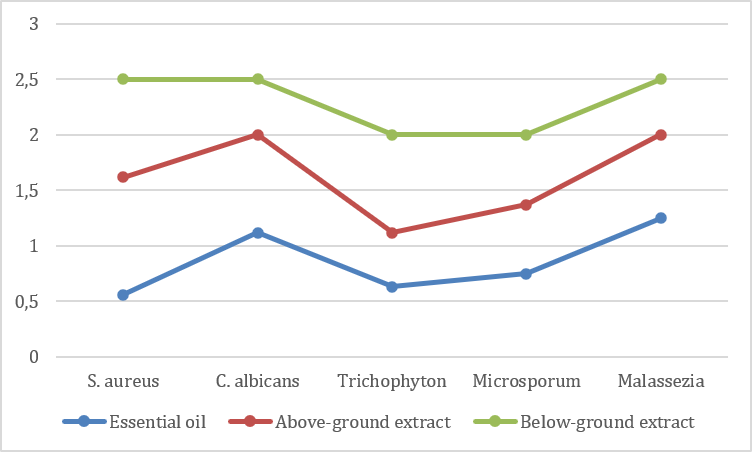
The essential oil demonstrated the most pronounced activity: the MIC was 0.5% for S. aureus and 1.0% for C. albicans. For dermatophytes, MIC values ranged from 0.5 to 1.25%, whereas for yeasts they were approximately 1.25%. Extracts obtained from the aerial parts showed moderate antimicrobial activity (MIC 1.0–2.5%), whereas extracts from the underground parts exhibited weak activity (MIC ≥2.0–2.5%), which may be related to the lower content of biologically active compounds and the organ-specific features of their distribution [58–61] (Figure 1). The high antimicrobial activity of the essential oil is attributable to the presence of monoterpenes (1,8-cineole, α-pinene), which are capable of disrupting cell membrane permeability and inhibiting microbial metabolic processes [62–64].
CONCLUSION. Thus, the findings of the present study demonstrate that the essential oil of S. rosmarinus cultivated in the Absheron region exhibits pronounced antimicrobial activity against both reference and clinical microbial strains, whereas extracts of the aerial parts exert a moderate effect and those of the underground parts only a weak effect. These data confirm the potential applicability of the essential oil in phytotherapeutic and dermatocosmetic formulations intended for the treatment of infectious and inflammatory diseases of the scalp.
Şəkillər
Açar sözlər
İstinadlar
1.Trüeb RM. The scalp microbiome and its role in dermatological disorders. Dermatology. 2021;237(5):647–656.
2.Borda LJ, Wikramanayake TC. Seborrheic dermatitis and dandruff: a comprehensive review. J Clin Investig Dermatol. 2022;10(1):1–8.
3.Gupta AK, Versteeg SG. Dermatophyte infections in the modern era. Mycopathologia. 2020;185(5):747–758.
4.Nenoff P, Verma SB, Ebert A, Süß A, Fischer E, Auerswald E. The current situation of dermatophytoses worldwide. J Fungi. 2021;7(2):117.
5.Dréno B, Pécastaings S, Corvec S, Veraldi S, Khammari A, Roques C. Cutibacterium acnes (Propionibacterium acnes) and skin diseases. J Eur Acad Dermatol Venereol. 2020;34(4):645–654.
6.World Health Organization. Global antimicrobial resistance and use surveillance system (GLASS) report 2023. Geneva: WHO; 2023.
7.Nieto G, Ros G, Castillo J. Antioxidant and antimicrobial properties of rosemary (Salvia rosmarinus): a review. Plants (Basel). 2022;11(3):345.
8.Man A., Santacroce L., Jacob R., Mare A., Man L. Antimicrobial activity of six essential oils against a group of human pathogens: A comparative study. Pathogens. 2019; 8(1): 15. https://doi.org/10.3390/pathogens8010015
9.Carneiro V.A., Melo R.S., Pereira A.M.G., Azevedo A.M.A., Matos M.N.C. et al. Essential oils as an innovative approach against biofilm of multidrug-resistant Staphylococcus aureus. 2020.
10.Sakkas H., Papadopoulou C. Antimicrobial activity of basil, oregano, and thyme essential oils // J.Microbiol. Biotechnol. 2017. Vol. 27, no. 3. P. 429–438.https://doi.org/ 10.4014/jmb.1608.08024.
11.Moumni S., Elaissi A., Trabelsi A., Merghni A., Chraief I., Jelassi B., Chemli R., Ferchichi S. Correlation between chemical composition and antibacterial activity of some Lamiaceae species essential oils from Tunisia // BMC Complement. Med. Ther. 2020. Vol. 20, art. 103. https://doi.org/10.1186/s12906-020- 02888-6.
12.Panahi Y., Taghizadeh M., Marzony E.T., Sahebkar A. Rosemary (Rosmarinus officinalis) oil in the treatment of androgenetic alopecia: a randomized comparative trial. Skinmed. 2015;13(1):15–21.
13.Koba K., et al. Chemical composition and biological activity of rosemary essential oil. Food Chem. 2017;214:462–471.
14.Mousavi S., et al. Topical rosemary oil versus 2% minoxidil for hair growth in androgenetic alopecia. J Dermatolog Treat. 2016;27(3):1–7.
15.Al-Sereiti M.R., Abu-Amer K.M., Sen P. Pharmacology of rosemary (Rosmarinus officinalis Linn.) and its therapeutic potentials. Indian J Exp Biol. 1999;37(2):124–130.
16.Shimizu K., et al. Antioxidant and hair growth-promoting activities of rosemary extract. Phytother Res. 2010;24(4):485–490.
17.Bozin B., et al. Antimicrobial properties of rosemary essential oil. Lett Appl Microbiol. 2007;44(6):408–412.
18.Farias M.A., et al. Rosemary as a potential agent for hair growth: current evidence and future perspectives. Dermatol Ther. 2020;33:e13548.
19.Morphobiological characteristics and essential oil of Rosmarinus Officinalis l. introduced in Absheron. BIO Web of Conferences 100, 04049 (2024) https://www.bio-conferences.org/articles/bioconf/abs/2024/19/bioconf_ifbioscfu2024_04049/bioconf_ifbioscfu2024_04049.html
20.Nieto G., Ros G., Castillo J. (2018).Antioxidant and antimicrobial properties of rosemary (Rosmarinus officinalis, L.): A review.DOI: 10.3390/medicines5030098
21.Əsgərov A. Azərbaycanın bitki aləmi. – Bakı : aa TEAS Press, 2016. – 444 s.
22.Elansary H.O., Szopa A., Kubica P., Ekiert H. (2020). Rosmarinus officinalis L.: Chemical composition, antioxidant and antimicrobial activity. Plants, 9(8), 1040.https://doi.org/10.3390/plants9081040
23.Nieto G., Ros G., Castillo J. (2020).Antioxidant and antimicrobial properties of rosemary (Salvia rosmarinus).Molecules, 25(6), 1293.https://doi.org/10.3390/molecules25061293
24.Hussain A.I., Anwar F., Sherazi S.T.H., Przybylski R. (2021).Chemical composition and antioxidant activity of rosemary essential oil.Journal of Essential Oil Research, 33(2), 120–128. https://doi.org/10.1080/10412905.2020.1863797
25.Yeshiwas Y., Tadesse A. (2022).Effect of environmental factors on essential oil yield of rosemary.Industrial Crops and Products,176,114318.https://doi.org/10.1016/j.indcrop.2021.114318
26.Borges A., et al. (2020)Antibacterial activity and mode of action of essential oils and their components.Frontiers in Microbiology https://doi.org/10.3389/fmicb.2020.00388 ; Nieto G., et al. (2020)
27.Antioxidant and antimicrobial properties of rosemary essential oil (Salvia rosmarinus). Moleculeshttps://doi.org/10.3390/molecules25061293 ; Hussain A.I., et al. (2021)
28.Chemical composition of rosemary essential oil and variability with environment. Journal of Essential Oil Research https://doi.org/10.1080/10412905.2020.1863797
29.Nazzaro F., et al. (2021)Essential oils and antimicrobial activity. Moleculeshttps://doi.org/10.3390/molecules26020345
30.Andrade J.M., et al. (2022) Bioactivity of phenolic compounds in medicinal plants. Phytomedicine.https://doi.org/10.1016/j.phymed.2021.153910;
31.Sharma S., et al. (2023)Rosmarinic acid: biological properties and antimicrobial potential. Food Chemistry.https://doi.org/10.1016/j.foodchem.2022.134217.
32.Liu X., et al. (2022) Distribution of secondary metabolites in plant organs and ecological regulation. Industrial Crops and Products https://doi.org/10.1016/j.indcrop.2022.114560;
33.Alimpić A., et al. (2021) Phytochemical variation in medicinal plants depending on plant organs. Plants https://doi.org/10.3390/plants10081564
34.Selmar D., Kleinwächter M. (2020) Stress enhances the synthesis of secondary metabolites in plants. Plants .https://doi.org/10.3390/plants9050591;
35.Hussain A.I. et al. (2021) Environmental factors affecting essential oil composition of medicinal plants. Journal of Essential Oil Research. https://doi.org/10.1080/10412905.2020.1863797;
36.Dong C.J., et al. (2021) Drought stress induces accumulation of phenolic compounds in plants. Frontiers in Plant Science https://doi.org/10.3389/fpls.2021.680998;
37.Sánchez-Gómez P., et al. (2022) Geographical variation in essential oil composition of aromatic plants. Industrial Crops and Products https://doi.org/10.1016/j.indcrop.2022.115123.
38.Seebacher C. et al. (2021) The dermatophytes: epidemiology and pathogenesis of tinea infections. Mycoses https://doi.org/10.1111/myc.13250;
39.Gaitanis G. et al. (2020) The Malassezia genus in skin disease. Frontiers in Cellular and Infection Microbiology https://doi.org/10.3389/fcimb.2020.00140;
40.Krcmery V., Barnes A.J. (2021) Non-albicans Candida spp. causing infections: epidemiology and clinical relevance.
Clinical Microbiology and Infection. https://doi.org/10.1016/j.cmi.2020.10.029;
41.Hay R.J. et al. (2020) Dermatophytosis: epidemiology and treatment update. The Lancet Infectious Diseases
https://doi.org/10.1016/S1473-3099(20)30164-8;
42.Gupta A.K. et al. (2022). Fungal infections of the scalp: current epidemiology and management. Journal of Fungi. https://doi.org/10.3390/jof8040351.
43.Totte J.E. et al. (2020) Staphylococcus aureus in skin disease: atopic dermatitis and beyond. Frontiers in Microbiology. https://doi.org/10.3389/fmicb.2020.591853;
44.Crespo-Erchiga V., Florencio V.D. (2021) Malassezia and bacterial interactions in skin disorders. Journal of Fungi
https://doi.org/10.3390/jof7010006;
45.Fox E.P. et al. (2020) Biofilms in mixed bacterial-fungal infections. Nature Reviews Microbiology. https://doi.org/10.1038/s41579-020-0402-7;
46. Mihaylova Y. et al.In vitro study of antimicrobial activity of essential oils of Lamiaceae family against Staphylococcus aureus ATCC 29213 and Candida albicans ATCC 10231.Proceedings of CBU in Natural Sciences and ICT. https://doi.org/10.12955/pns.v3.318.
47.Tkachenko H. et al. (2023) In vitro antibacterial activity of rosemary essential oil against clinical and reference strains.
Scripta Scientifica Pharmaceutica. https://doi.org/10.32999/ksu2524-0838/2023-35-5;
48.Kullberg B.J., Arendrup M.C. (2021) Invasive candidiasis. Clinical Microbiology and Infection. https://doi.org/10.1016/j.cmi.2020.10.029;
49.Nieto G. et al. (2020) Rosmarinus officinalis essential oil: chemical composition and antimicrobial activity. Molecules. https://doi.org/10.3390/molecules25061293.
50.Daglia M. (2021) Molecules. Polyphenols as antimicrobial agents in plant-based systems https://doi.org/10.3390/molecules26092300;
51.Cushnie T.P.T., Lamb A.J. (2020) International Journal of Antimicrobial Agents Recent advances in understanding antibacterial properties of flavonoids https://doi.org/10.1016/j.ijantimicag.2020.106010 ;
52.Alimpić A. et al. (2021). Plants (MDPI) Phytochemical variability among plant organs in medicinal species. https://doi.org/10.3390/plants10081564;
53.Xu L., Wang X. (2025). International Journal of Molecular Sciences Distribution of secondary metabolites in plant organs under environmental regulation https://doi.org/10.3390/ijms26125767.
54.Jin D. et al. (2020) Secondary metabolites profiled in different plant organs (leaves, stems, roots). Scientific Reports. https://doi.org/10.1038/s41598-020-60172-6;
55.Pang Z. et al. (2021) Linking plant secondary metabolites and plant microbiomes. Frontiers in Plant Science https://doi.org/10.3389/fpls.2021.621276;
56.Zhou P. et al. (2024).Spatial metabolome of aerial and underground plant parts. Phytomedicine. https://doi.org/10.1016/j.phymed.2023.155259
57.Palazon J., Alcalde M.A. (2025). Secondary metabolites in plants.Plants https://doi.org/10.3390/plants14142146
58.Elshafie H.S., Camele I. (2023) A comprehensive review on plant secondary metabolites and their biological activity
International Journal of Molecular Sciences. https://doi.org/10.3390/ijms24043266;
59.Yang W. et al. (2024). Plant secondary metabolites-mediated plant defense against bacteria and fungi pathogens. Plant Physiology and Biochemistry. https://doi.org/10.1016/j.plaphy.2024.109224;
60.Li X.C. et al. (2024). Antimicrobial secondary metabolites: sources and opportunities Frontiers in Plant Science. https://doi.org/10.3389/fpls.2024.1382604; Rasheed A. et al. (2024) Distribution and ecological role of plant secondary metabolites Plants. https://doi.org/10.3390/plants13223162;
61.Zhang Y. et al. (2026). The rhizosphere as a source of bioactive compounds Rhizosphere. https://doi.org/10.1016/j.rhisph.2026.101298.
62.Merghni A. et al. (2023) 1,8-Cineol (Eucalyptol) disrupts membrane integrity and induces oxidative stress in MRSA
Antioxidants.https://doi.org/10.3390/antiox12071388;
63.Shahina Z. et al. (2022).Rosemary essential oil and its components induce cell death in Candida albicans. PLOS ONE.https://doi.org/10.1371/journal.pone.0277097;
64.Sharifi-Rad J. et al. (2021) Natural products and antimicrobial mechanisms of essential oils. Frontiers in Microbiology
https://doi.org/10.3389/fmicb.2021.621276;
65.Silva N.C.C., Fernandes Júnior A. (2020) Biological properties of medicinal plant terpenes. Molecules https://doi.org/10.3390/molecules25163663;
Məqalə barədə təfərrüatlar:

Nəşr tarixçəsi

Dərc edilib: 13.Oct.2026

Müəllif hüququ
© 2022-2025. Azərbaycan Tibb Universitetinin nəşri. Jurnalın elektron versiyası "Uptodate in Medicine" tibb nəşriyyatı tərəfindən dərc olunur. Bütün hüquqlar qorunur.Əlaqəli məqalələr
Baxılıb: 10